An Old English Herbal
I am here with an update on my manuscript transcription. I first and last discussed this in the enthusiastically-titled post, New Project! back in mid October. Life has been quite busy since then but I have not abandoned my quest. In fact, I printed out the first page on three separate, dramatically zoomed in on three of the four quadrants. The first page looks like this:
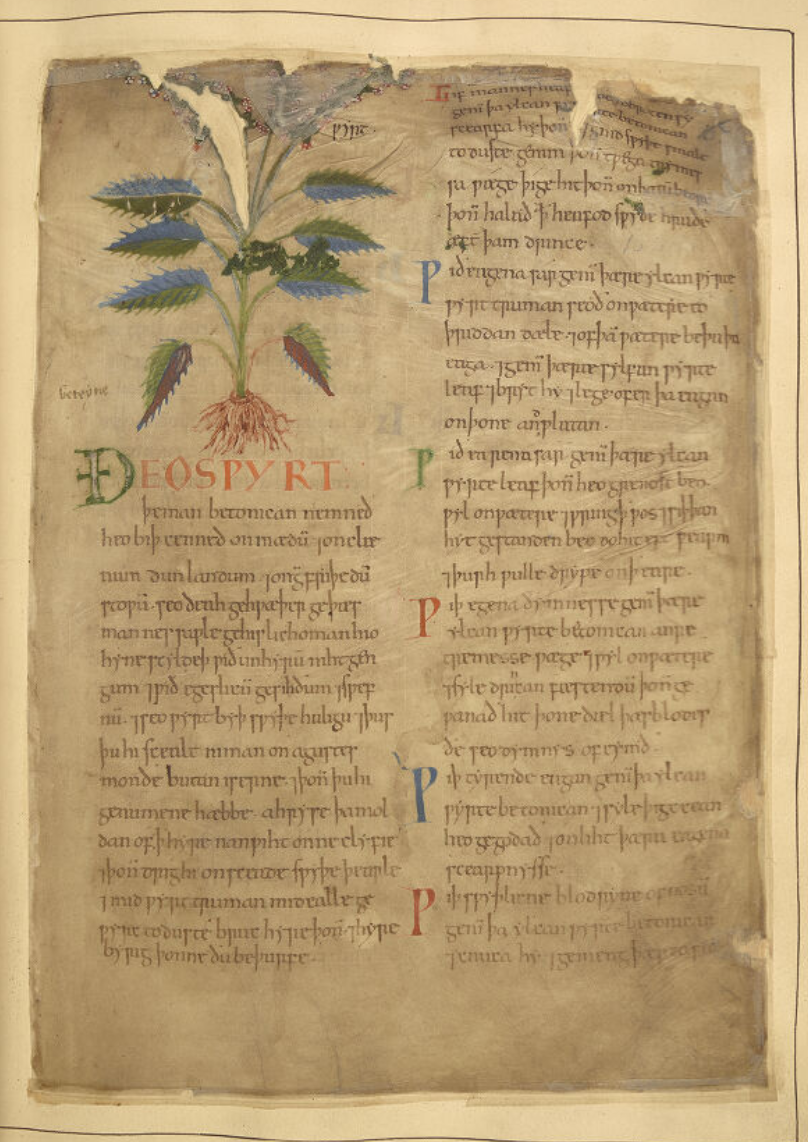
These came on some travels with me and I made about a page and a half, or about line 26 in the transcription below. I then got distracted by the whole November and December whirlwind and made very little progress. When I came back to it seriously, I found myself second-guessing everything I'd done and ended up going back to the one existing transcription I could find, Thomas Oswald Cockayne's Leechdoms, Wortcunning, and Starcraft of Early England. As you may or may not recall from my earlier post, I had given up on trying to OCR the hopeless jumble of alphabets contained in this book and was working straight from the manuscript, a wonderful decision when a manuscript is so stunningly beautiful. His own transcription is quite dated and I found myself making more modern choices, though not with perfect consistency. After transcribing, there will be the task of normalizing and translating that will be a significant amount of work.
I do this for fun.
That said, here is the first page transcribed line by line starting with that beautiful capital eth. Delightfully (this is sarcasm), the page cuts off mid-word and I am going to have to go straight on to 20v of the manuscript. I have also to added a quick and dirty translation below the transcription for the satisfaction of those who are interested but don't want/have the ability to read the OE text. For those in the know, I have saved the þ and ð and æ characters as well as the Tironian et (this thingy: ⁊) but have opted to replace the wynn with a regular "w".
- Ðeoswyrt
- þeman betonican nemneð
- heo biþ cenneð on mædum ⁊ clæ-
- num dunlandum ⁊ onġefriþerdum
- stowum seo ðeah ġehwæþer ġeþæs
- mannes sawle ġehir lic-homan hio
- hyne scyldeþ wið unhirlic nihtgen-
- gum ⁊ wið egeslicum gesihðum ⁊ swef-
- num. ⁊ seo wyrt byþ swyþe haliga ⁊ þur
- þu hi scealt niman on agustes
- monðe butan iserne on þonne þu hi
- genumene hæbbe ahnyse þa mol-
- ðan of þæt hyre nanwiht onneclyfie
- ⁊ þonne ðrig hi onsceaðe swyþe þearle
- ⁊ mid wyrt truman mid ealle ge-
- wyrc to duste bruc hyre þonne ⁊ hyre
- byrig þonne ðu beþurfe.
- Lif mannes heafoð tobrocen sy
- genim þa ylcan wyrte betonican
- scearfa hy þonne ⁊ genid swyþe smale
- to dufte genim þonne twega trymes-
- sa wæge þige hit þonne on hatum beore
- þonne halað þæt heafod swyðe hraðe
- æfter þam drince.
- Wið eagena sar genim þáre ylcan wyrte
- wyrt truman reoð onwætere to
- þriddan dæle ⁊ ofþæm wætere beþa þa
- eag. ⁊ genim þæræ sylfan wyrte
- leaf ⁊ bryt hy ⁊ lege ofen þa eagan
- on þone and-wlatan.
- Wið earena sar genim þære ylcan
- wyrte leaf þonne heo grenost beo
- wyl on wætere on wring þæt wos ⁊ siþþan
- hyt gestanden beo do hit eft wearm
- ⁊ þurh wulle drype on þæt eare.
- Wiþ egena dymnessa genim þære
- ylcan wyrte betonican anre
- tremesse wæge ⁊ wyl on wætere
- ⁊ fyle druncan fæstendum þonne ge-
- wanað hit þone dæl þæs blodes
- ðe seo dymnys of cymð.
- Wiþ tyrende eagen genim þa ylcan
- wyrte betonican ⁊ syle þigccean
- heo ġegodað ⁊ onliht þæra eagena
- scearpnysse.
- Wiþ swyþlycne blodryme of nosum
- genim þa ylcan wyrta betonican
- ⁊ cnucn hy ⁊ gemeng þærto su- (here the page cuts off)
Translation:
1. This plant
2. that is called betony
3. it is found in meadows and
4. clean downlands and shaded
5. places. It is good whether for
6. man's soul or for his body (this word is literally lich-home), she
7. him shields against monstrous night-
8. walkers and against horrible visions and
9. dreams. And this herb is very wholesome and thus
10. you shall gather in August
11. month but with no iron; and when you it
12. have gathered, shake the mold
13. off that to it no whit shall cleave
14. and then dry it in the shade exceedingly and completely
15. and with the plant root all together
16. work it to dust, take of it and
17. taste when you need.
18. If a man's head be broken,
19. take that same herb betony,
20. scrape it and knead it very small
21. into dust. Take from it two drams
22. weight, and consume it in hot beer,
23. then that head will heal very quickly
24. after the drink.
25. For sore eyes, take the same herb's
26. plant-root and boil in water to the
27. third part (reduce to a third) and of that water bathe the
28. eye. And take that same herb
29. leaf and break (bruise) it and lay it over the eye
30. on the face.
31. For sore ear, take this same
32. herb leaf when it is greenest,
33. boil in water and wring the juice and when
34. it be stood (cooled, I think?), make it again warm
35. and through wool, drip it in the ear.
36. For dimness of eye take there
37. this same herb, betony, one
38. dram weight and boil in water
39. and give to drink while fasting, then
40. it wanes from him the blood
41. from which the dimness comes.
42. For teary eyes, take the same
43. herb betony and give to drink,
44. it will do good and light the eyes
45. sharpness.
46. For sever bloodflow from the nose,
47. take the same herb betony
48. and knock it and mix thereto (here my word is interrupted, but I looked ahead)
49. some deal of salt... (TO BE CONTINUED)
This is on pages 71 and 72 of Leechdoms, wortcunning, and starcraft of early England, which correspond to pages 193 and 194 of the Internet Archive PDF. The manuscript itself can be found through the British Library in their online archive, here: Cotton MS Vitellius C III, starting on 20r.